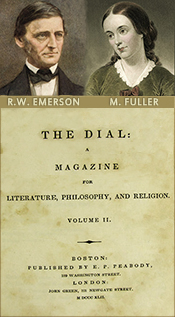
God, I love the Transcendentalists. Or at least I love reading about them.
The key word there is about, since with the exception of Thoreau’s Walden, I find it tough going to get to the end of almost any of the major works.
I can only take so many Latinate adjectives, multiple subordinate clauses and classical allusions harnassed to a high-minded experimental theory for the sole purpose dragging me to higher moral ground before I revolt and pick up Balzac or Henry Miller or some other entertaining, realistic, sensuously cynical writer. After Shiloh, Verdun, the Holocaust, the gulag, the Iron Curtain and the never-ending violence that is the modern Middle East, it’s hard to take the notion that man is innately good and society perfectable if only <insert writer’s pet theory here.> Nature is diminished in a post-Darwin world, and Self-Reliance pales after Nietzsche. Hindsight is 20/20 and it’s hard to leave my 20th-century mindset behind.
But God I love them, as goody-goody, stuffy, cerebral and flawed as they were.
I love them for their active hopefulness in the face of the terrible, hard world in which they lived, a world of fewer creature comforts than ours, of a classism we could never dream of, rampant sexism, uncertain health and sudden death. Emerson lost his first wife, and a child. Thoreau’s brother died of lockjaw. (Think about that – lockjaw.) Margaret Fuller underwent painful and likely quack treatments for a spinal ailment. They lived in a world where it was legal to buy and sell people based on the color of their skin (in the US) or their parentage (in Russia.) They were no strangers to pain and suffering, and yet they looked on the human spirit as divine, and capable not just of transforming and bettering itself but of transforming and bettering the whole world. That’s what reform meant to them: re-making themselves and the world in new image. It follows from their divinity-school Puritan religious roots. Repent = rethink. Reform= remake.
It’s hard to love earnest people. It’s even harder to read them.
But this summer I am going to try and read my way through the Transcendentalist canon. I feel like I owe it to them for being the first real native-born American do-gooder generation – the original bleeding-hearts, if you will. And I owe it to myself as a thinking woman and an American whose whole formal and informal education – in history, literature and culture– was outward facing, Euro-facing. American Transcendentalism was born in the heart of German esoterics and died in the face of American practicalities. I want to see if their spirit is somehow living in the heart of this practical American.
Maybe I’ll find that it’s not. But at least I can read. And rethink. And remake. Maybe.
Transcendentalist reading list for June:
Margaret Fuller Summer on the Lakes
Margaret Fuller Woman in the Nineteenth Century
.
 helloclio